People who believe that dehumanization is a thing of the past are gravely mistaken. A study conducted by Ktiely and Bruneau shows just how prevalent dehumanization is in the modern day. The goal of this study was not only to see just how frequent dehumanization is in today’s society, but to also assess the repercussions of blatant dehumanization.[1] In this study, a sample of individuals from 4 different countries were asked to rate other groups of people, using the “Ascent of Humans” diagram and to determine how evolved they thought each group was.[1]
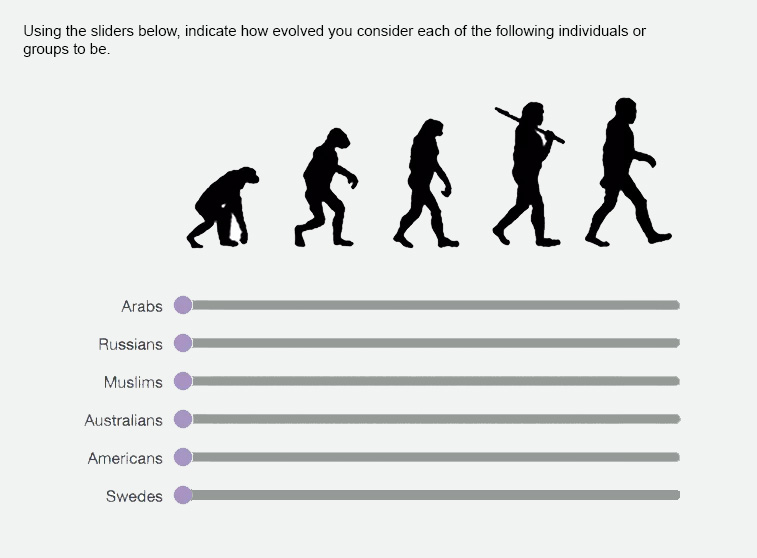
The results of study showed that, Americans rated themselves, Europeans, Japanese, and Australians high on the scale. While others groups such as Mexican immigrants, Arabs and Muslims were rated lower.[1]

The results of the study, gathered from Ktiely and Bruneau, prove that dehumanization is still very common in contemporary times, and that many negative repercussions are associated with dehumanization. In the study, they found that dehumanization is commonly linked to hostile attitudes towards certain groups of people.[1] They specifically state that those who dehumanize more were more likely to support the cruel treatment of Muslims and Arabs or support petitions that call for congress to implement more strict immigration policies of Muslim and Mexican immigrants.[1] This study is significant because it supports the fact that dehumanization is a precursor to hostile attitudes which can pave the way for harsh acts against a group of people, thus creating opportunities for dark moments in history to occur once more.
In another journal article, Esses highlights how the media plays a significant role in the dehumanization of others. This article explores how in many countries people view immigrants and refugees as a threat, and that is mainly a result of the media’s tendency to focus more on negative stories of immigrants and refugees.[2] Esses discusses how these negative views of immigrants and refugees combined with feelings of uncertainty can result in people dehumanizing them.[2] This is dangerous because media platforms and public figures who broadcast negative views of certain groups can influence the population to adopt these harmful views. Once a large amount of people in society adopt these views then the persecution of certain groups of people is inevitable.
What should be done?
Gregory H. Staton, the president of Genocide Watch, offers some insight on ways societies can combat the effects of dehumanization and prevent genocide. Stanton claims that “local and international leaders should condemn the use of hate speech and make it culturally unacceptable” and that “leaders who incite genocide should be banned from international travel and have their foreign finances frozen.”[3] Staton also says that any media outlets that promote hate speech should be shut down.
Vox states that the best way to combat dehumanization is to understand people who are different from you and to see things from their point of view.[4]
Not only that, but individuals must educate themselves on current events and not simply take everything thing they see on media platforms at face value. If you find yourself agreeing with the harsh treatment of others, due to what an article or someone says online, then investigate. Look deeper into the dilemmas at hand and question the credibility of the source. Do your own research and look at multiple media platforms or other credible sources before jumping into conclusions that could potentially harm a group of people.
Sources:
[1]Kteily, Nour S., and Emile Bruneau. “Darker Demons of Our Nature: The Need to (Re)Focus Attention on Blatant Forms of Dehumanization.” Current Directions in Psychological Science, vol. 26, no. 6, Dec. 2017, pp. 487–494, doi:10.1177/0963721417708230.
[2]Esses, Victoria M., et al. “Uncertainty, Threat, and the Role of the Media in Promoting the Dehumanization of Immigrants and Refugees.” Journal of Social Issues, vol. 69, no. 3, Sept. 2013, pp. 518–536. EBSCOhost, doi:10.1111/josi.12027.
[3]Stanton, George H. “The 8 Stages of Genocide.” Genocidewatch.org, http://www.genocidewatch.org/aboutgenocide/8stagesofgenocide.html.
[4] Resnick, Brian. “The Dark Psychology of Dehumanization, Explained.” Vox, Vox, 7 Mar. 2017, https://www.vox.com/science-and-health/2017/3/7/14456154/dehumanization-psychology-explained.
 Denying Others Of Their Humanity